The Steeple & Bell Chamber
Old North’s soaring steeple and resonant bells are two of the church’s most iconic features. We invite you to see our steeple in-person, take a guided tour of our bell ringing chamber, or dive into the church’s history using the resources below.
Learn About Our Historic Change Ringing Bells
Take a bell chamber tour or learn online.

$15 adults; $10 youth (5 & under free)
Guided tour
Discovery Pass + Bell Chamber Tour
Includes a guided tour of the bell ringing chamber where Paul Revere rang bells as a teenager, and everything in the Discovery Pass.
$15 adults; $10 youth (5 & under free)
Guided tour
Discovery Pass + Bell Chamber Tour
- Includes everything in the Discovery Pass
- Enjoy a 25-minute behind-the-scenes tour of the bell chamber
- See where Paul Revere rang bells
- Learn about “change ringing” and the steeple
- Group sizes range from 1–20 people
- Tour requires climbing two sets of steep stairs
99% Sure
Mythbusting: The Bells of Old North
In this video, Old North Researcher TJ Todd debunks persistent legends and tells the true history behind our bells.
99% Sure
If you’ve ever been to Boston’s North End on a Saturday or Sunday, you may have heard cascading bells echoing throughout the neighborhood. Those are Old North’s change ringing bells: this is a specialized style of ringing using particular patterns, rather than playing a song – that’s what gives them that cascading, flowing sound. There are actually a couple of persistent legends about these bells, so let’s start by dispelling those, and along the way, we can learn a lot of their true history in the process.
BLOG
The Jewells of Old North
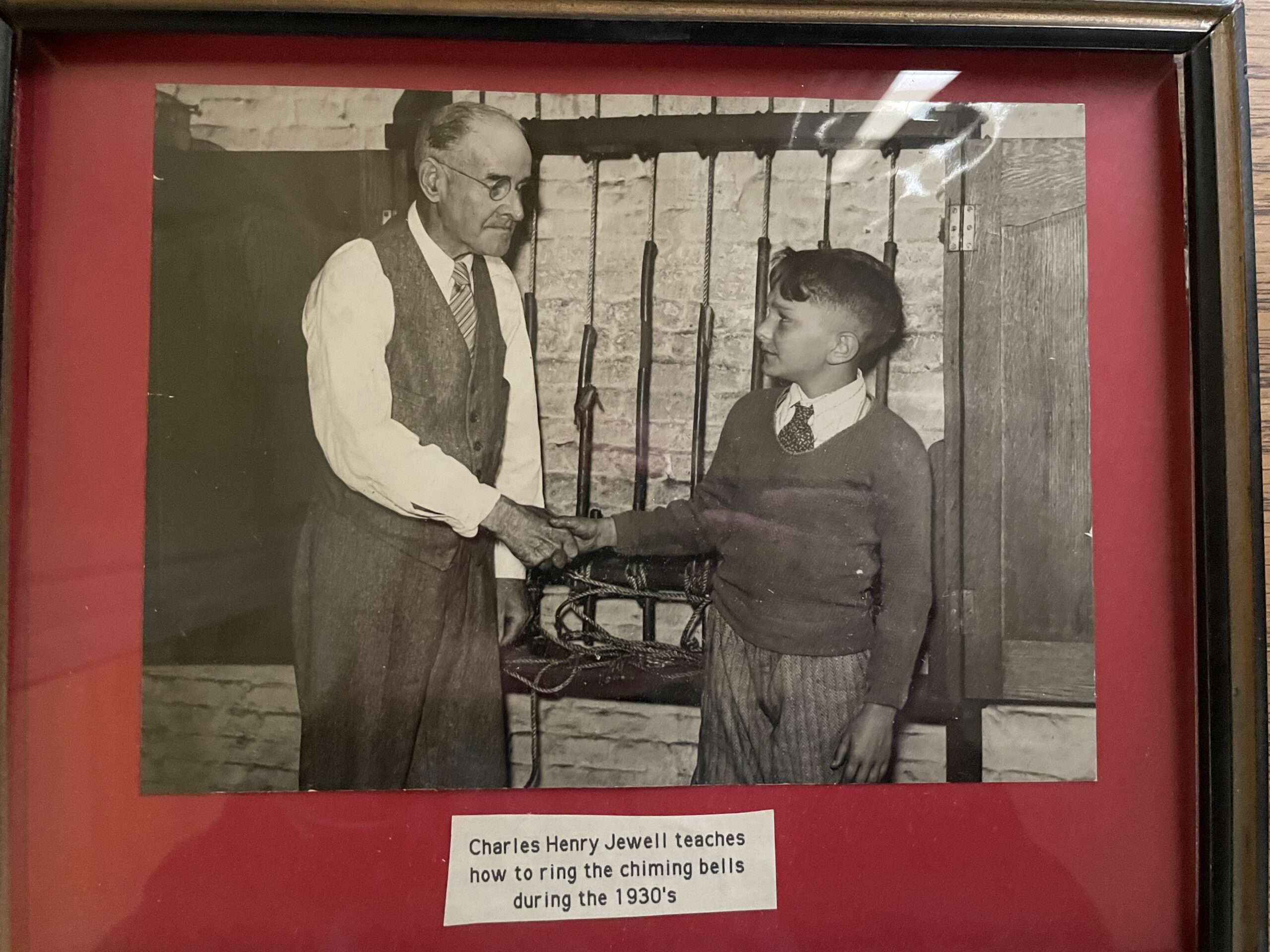
For nearly a century, a member of the Jewell family rang the historic bells at Old North Church. Learn about their family history.
BLOG
For nearly a century, a member of the Jewell family rang the historic bells at Old North Church. John H. S. Jewell began ringing the bells in 1847 and created a family tradition by teaching his younger brother Frederick Morse Jewell how to ring. The tradition continued when Frederick’s son, Charles Henry Jewell, took over for his father in 1888. Charles rang Old North’s bells until he retired from bellringing in the summer of 1935, aside from a short period from 1894 to 1895 when the Old Colony Guild of Bell Ringers took over the ropes
The Story of the Steeples
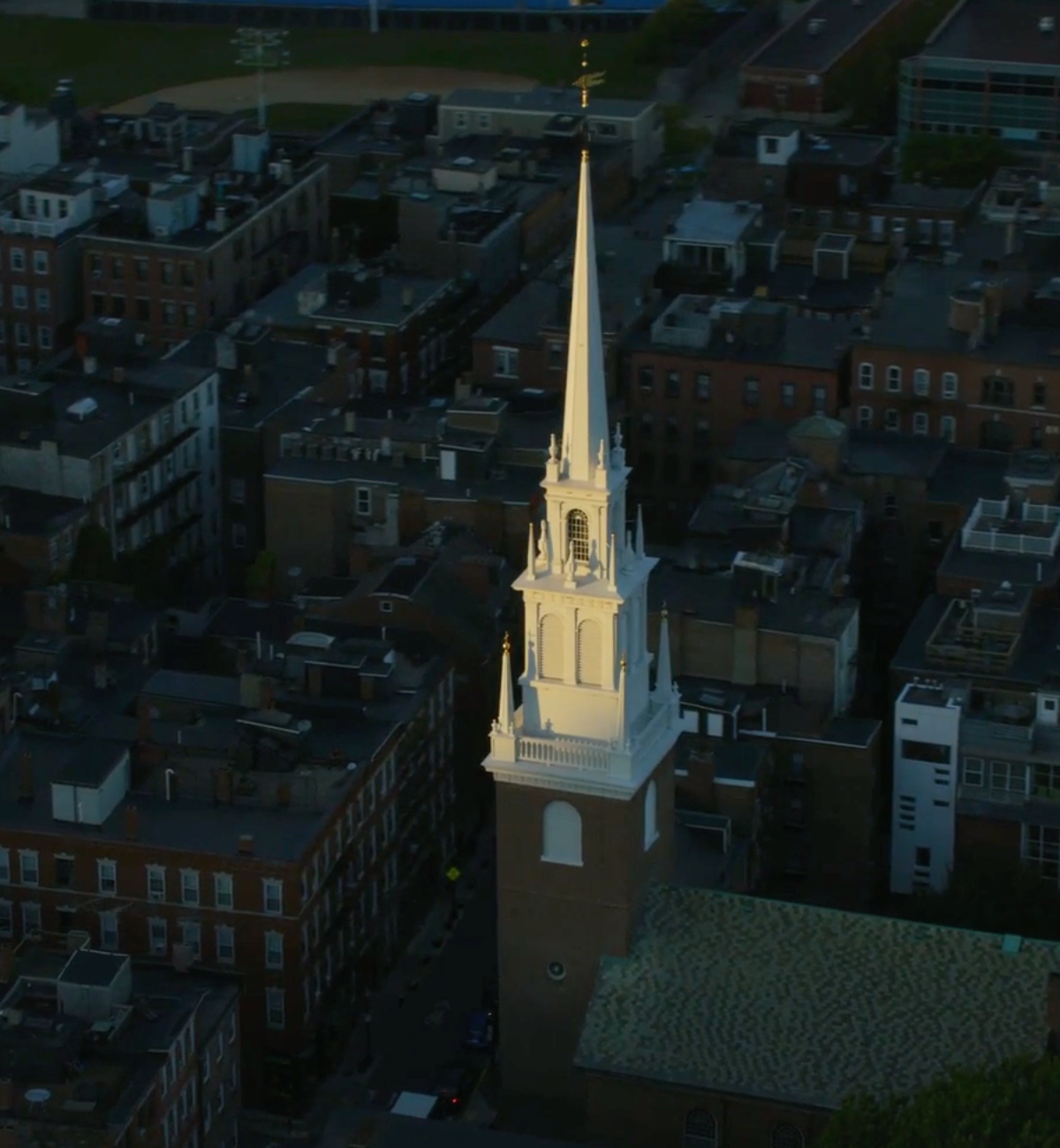
Old North’s iconic steeple may be one of the most memorable images along the Freedom Trail — but did you know that the steeple you see today is actually Old North’s third steeple? Yes, that’s right! Not once, but twice, powerful storms have blown down the spire (the wooden section atop the brick tower), resulting in community efforts to rebuild. The story of the steeple is a story of teamwork, commitment, and active citizenship over the centuries. It is also a story that invites us to reflect on the complexity of Old North’s past.
For Old North’s first 17 years (1723-1740), there was no wooden spire on top of the brick tower. Imagine how different it must have looked! In 1737, church leaders began a subscription campaign to collect money to fund the construction of the spire. A large early gift came from a group known as “The Gentlemen of the Bay of Honduras” who donated a ship’s entire cargo load of logwood, a valuable commodity grown in the tropics. The church sold the logwood and put the proceeds in the fund. Other supporters and congregants made gifts—some larger, some smaller—as well. In the summer of 1740, the wooden spire was built in a nearby field. Workers hoisted it onto the tower and then celebrated with a feast. The finished steeple, topped with a golden weathervane, made Old North the tallest structure in Boston. Its impressive height and elegance were a statement by the young congregation.

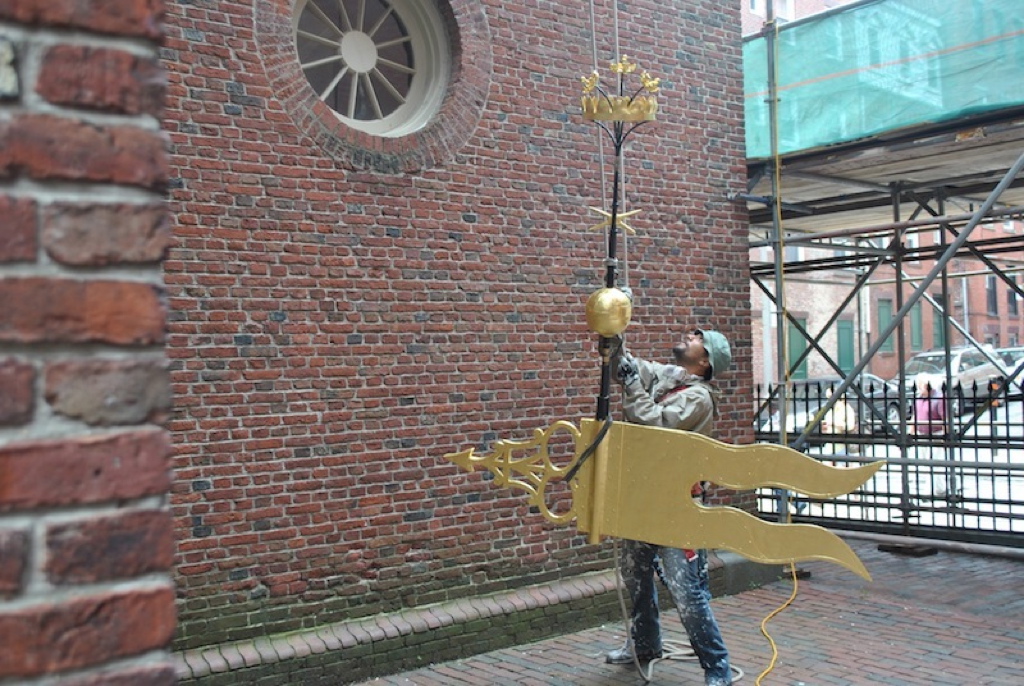
Topping the Old North steeple(s) for almost 300 years is the golden weathervane created by Shem Drowne. Drowne made some of the most iconic weathervanes of the colonial era, including the grasshopper that graces Faneuil Hall.
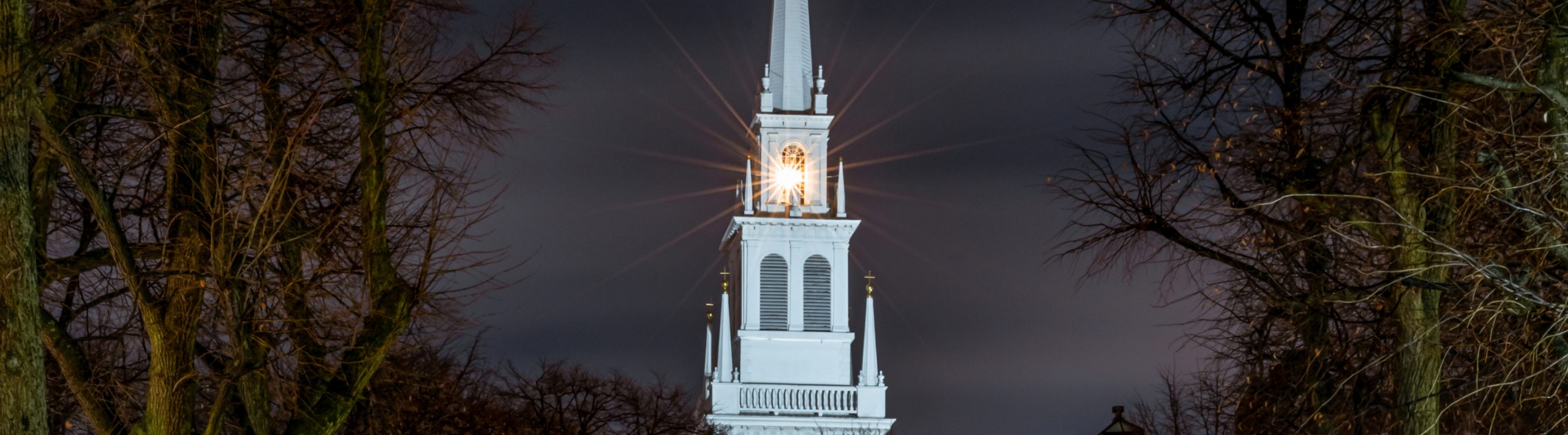
In the 1700s, Old North’s steeple was the tallest point in Boston and could be seen from quite a distance — and that turned out to be very important. If we could go back in time to April 1775, we would be in a very divided city. There was a huge military presence — British troops were everywhere. There was tension building. Some residents were Loyalists, some were neutral, and some were resisting British laws and policies until they had representation. That last group, whom we call ‘Patriots’ included a group known as the Sons of Liberty whose members were men like Samuel Adams, John Hancock, and Paul Revere. Back in April of 1775, the Sons of Liberty were very concerned about reports that British General Thomas Gage was planning to send troops to seize munitions stockpiled in the town of Concord. The Sons of Liberty needed a plan for how to spread the word quickly and widely as soon as the troops went on the move. Equally importantly–the message needed to include whether the troops were taking the land route or the shorter, but more complicated, water route. Paul Revere’s ability to problem solve came to the rescue. He suggested that they use Old North’s steeple–specifically, use a lantern signal shining from the steeple, to alert a network of riders waiting across the river. A simple signal: “one if by land and two if by sea”.
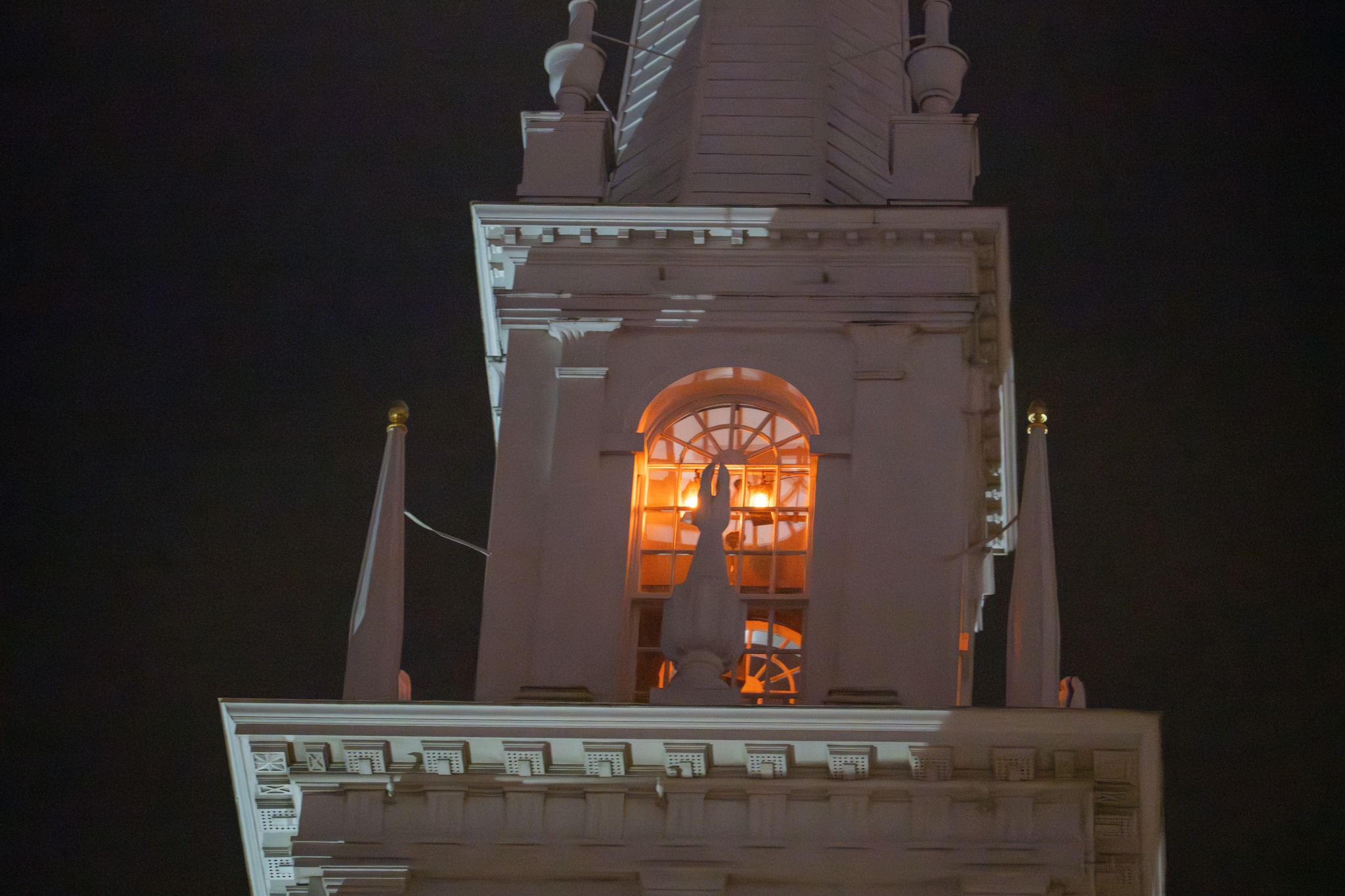
And that’s what happened on April 18, 1775. Spies learned that the British were taking the water route. Revere passed the word on to activate the plan – with his own ride to do, and so many towns and villages to alert, Revere could not do it all on his own; it would require a lot of teamwork for the plan to be successful. So, Old North’s sexton, Robert Newman and vestryman John Pulling, Jr. broke curfew and entered the church late in the evening. They climbed up the tower to the top of the steeple where they held two lanterns for about one minute. Those two signal lanterns set a complex alarm system into motion, a system that included many people fanning out across Massachusetts that night. Once Revere got across the river, he began his own famous ride as part of this system.
Ultimately, when the British arrived in Lexington the next morning they were met by local militia members and the shots fired that morning ignited the American Revolutionary War.

In October of 1804, Boston was struck by a ‘very violent gale’ that blew the wooden spire from Old North’s tower, destroying a house below. There was no salvaging it. Once again, church leaders appealed to members of the congregation and to community members throughout Boston and neighboring towns. By 1806, enough money had been raised to build a second wooden spire. This one was fifteen feet shorter than the original, and while it had similar windows and was topped by the original weathervane, other decorative elements were altered. This same year, Old North underwent a interior redesign as well, changing the location of the pulpit and the layout (and design) of the pews. Do these changes suggest that the early 19th century congregation thought of Old North not as a historic icon but simply as their church, which could and would be changed to reflect their time and taste?

The second spire lasted until August 1954 when Hurricane Carol pummeled Boston. Spectators anxiously watched the spire teeter and sway until finally it fell across Salem Street and into Hull Street. The only damage was a small chunk dislodged from the masonry of a building on the corner of Salem and Hull.
Once again, only the weathervane survived.

“As the family story goes, while some of the locals took bits and pieces of the steeple as souvenirs, my uncle absconded with [a piece of ] the weathervane and convinced my dad to hide it in our apartment. Supposedly they stashed it in my bedroom. I was just a week away from turning eight months old at the time. For days the media put out the call for its return. My dad finally convinced my uncle that it was too hot to handle and should be returned. Late one night they carried it down to the waterfront, then made an ‘anonymous’ call to the police for its recovery. Every time I look up at the steeple I smile knowing that for a short while I slept in the same room with the weathervane.”
– Rep. Peter Petrigno, NH State Representative, former North End resident

Rebuilding Old North’s steeple became a national project, reflecting Old North’s national prominence as a symbol of freedom and of the American Revolution. Funds flowed in from across the country and from people of all ages.
“While in the 4th grade, and living in Morocco, I collected money to support the Old North. I remember my father who also loved history, talking about the Old North, the battle at Lexington, the USS Constitution, and the values they represented… risk, teamwork, vision of a better country. Not long after, there was a drive to support the Old North and the USS Constitution. I volunteered to go door to door among the Americans to collect money. While I thought I did great, even if many others collected more than I did, it was the values my father expressed and how the role of the Old North built on those values that never left me.”
– Anne Bailey Berman, former Old North Foundation Board Chair
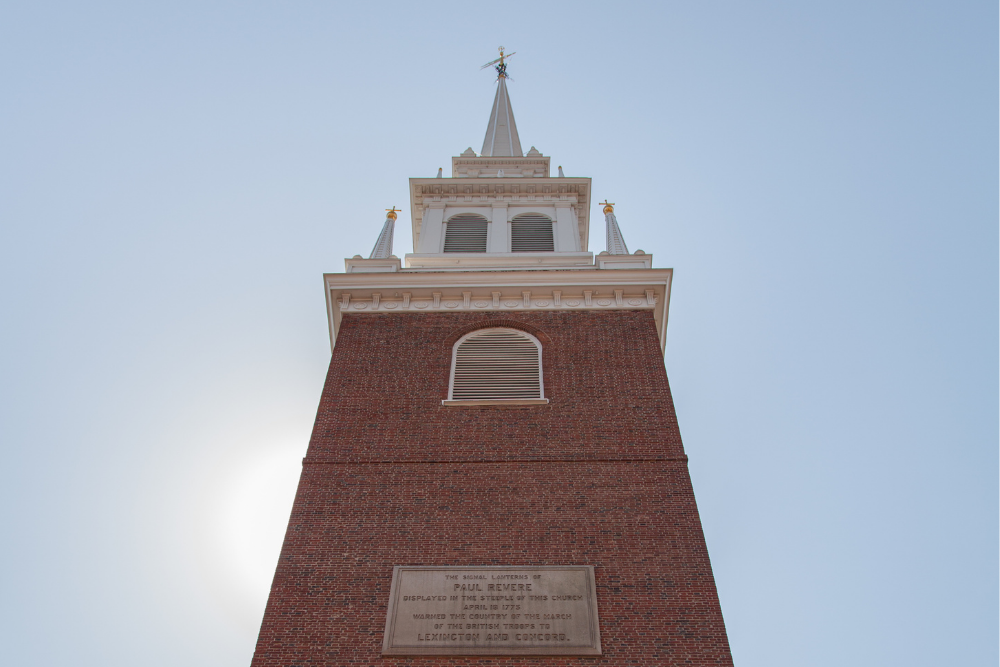
In October 1955, the third steeple, topped by Shem Drowne’s weathervane, was hoisted into place and secured with steel reinforcements. This time, the steeple was a deliberate replica of the original, consciously recalling the colonial identity and prominence of the structure. Old North’s steeple has become a visual evocation of the nation’s values, struggles, and transformation.


Sifting through a filing cabinet of old photographs and documents brought to light a story that has been forgotten by most people, even at Old North. Two newspaper clippings had been saved — the first from a newsletter once issued by the vicars of Old North, and the second from The Boston Sunday Herald, both detailing the incredible 1976 project to harness light from a star 200 light-years away to illuminate the replica lanterns hanging in the Old North Church for the Bicentennial.
The inventive idea was first proposed by D. Wilson Benware, an amateur astronomer in California, to the Hawai’i Bicentennial Commission. But it was astronomer Dr. Sidney Wolff whose efforts at the University of Hawai’i’s Mauna Kea Observatory brought the star, Epsilon Lyrae, into focus. At the time, the Mauna Kea Observatory was the highest in the world at an elevation of 13,796 feet. In fact, Dr. Wolff arrived a day early to allow herself to adjust to the high altitude.
America’s Oldest Set of Change Ringing Bells
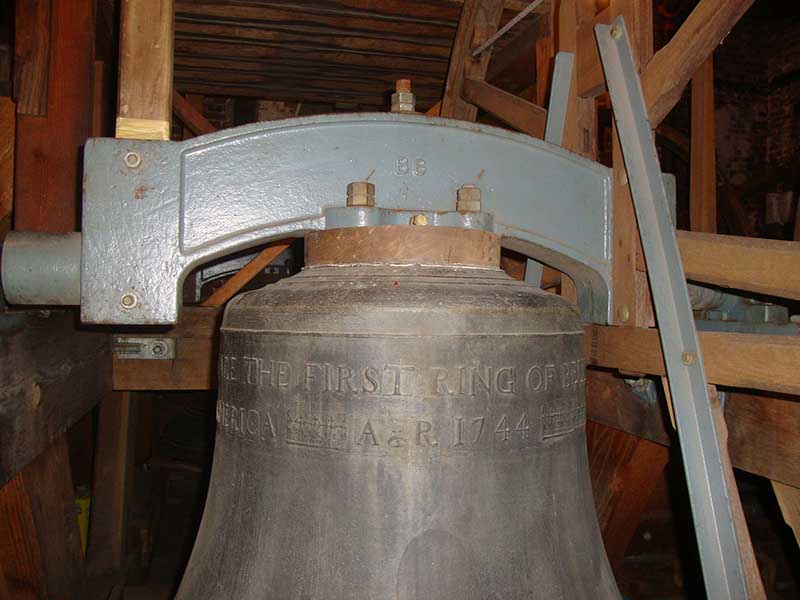
Cast in 1744 in England by the Rudhall family bell foundry in Gloucestershire and weighing over 5,000 pounds, the Old North bells were the first set of change-ringing bells (rotating bells mounted on wheels) in the British American colonies.
The transport of the bells to Boston and their subsequent installation in Old North’s belfry tower were exceptional feats at a time when few churches even in England had peal bells. Completion of the steeple in 1740 with the addition of the peal of bells in 1745 concluded the initial two- decade long construction of Christ Church. By its size and its visual prominence, the church asserted imperial authority in Puritan Boston, then the largest urban center and the largest port in British North America. Subscribers contributing to the cost of the bells included British naval officers, nobility in England, and wealthy plantation owners in the Caribbean.
The bells were restored in 1894 and then mostly idle. They were restored (again) in 1975 with the help of Geoffrey Davies, of Simon W. Robinson Lodge in Lexington, for the Boston Bicentennial celebration. They have been rung regularly ever since.
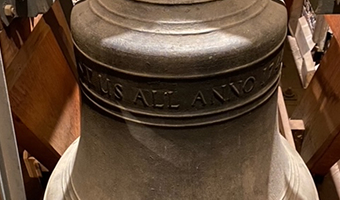
Each bell is cast with an inscription. See the eight bells of Old North Church in the section below.
Bell 1
Sound: (Treble) F, Weight: 5 cwt, 2 qr, 4 lbs
Inscription: Abel Rudhall of Gloucester, cast us all, Anno 1744.
Bell 5
Sound: (Treble) B flat, Weight: 7 cwt, 1 qr, 21 lbs
Inscription: God preserve the Church of England. 1744.
Bell 2
Sound: (Treble) E, Weight: 5 cwt, 2 qr, 6 lbs
Inscription: Since generosity has opened our mouths, our tongues shall ring aloud its praise. 1744.
Bell 6
Sound: (Treble) A, Weight: 8 cwt, 1 qr, 24 lbs
Inscription: We are the first ring of bells cast for the British Empire in North America. A.R. 1744.
Bell 3
Sound: (Treble) D, Weight: 6 cwt, 1 qr, 3 lbs
Inscription: The subscription for these bells was begun by John Hannmock and Robert Temple, Church Wardens, Anno 1743; completed by Robert Jenkins and John Gould, church Wardens, Anno 1744.
Bell 7
Sound: (Treble) G, Weight:10 cwt, 2 qr, 24 lbs
Inscription: This Church was founded in the year 1723. Timothy Cutler, DD, the first Rector, A.R. 1744
Bell 4
Sound: (Treble) C, Weight: 7 cwt, 1 qr, 3 lbs
Inscription: William Shirley, Esq., Governor of the Massachusetts Bay, in New England. Anno 1744.
Bell 8
Sound: (Tenor) F, Weight: 13 cwt, 3 qr, 5 lbs
Inscription: This peal of eight bells is the gift of a number of generous persons to Christ Church, in Boston, N.E. Anno 1744. A.R
Old North Church is home to the oldest set of change ringing bells in the United States. They were cast in Gloucester, England and installed in the steeple of Old North in 1744. In 1750, the first Guild of Bell Ringers for the Old North was established by a group of young men from the North End and included fifteen-year-old Paul Revere. These young men wrote up a contract with the minister of the church, Rev. Timothy Cutler, in which they agreed to ring the bells once a week for two hours and in exchange would be paid three shillings for each service.
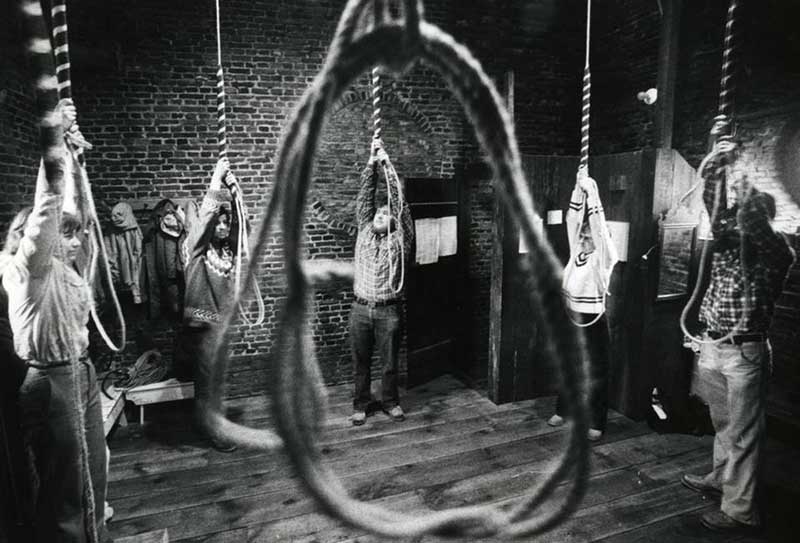
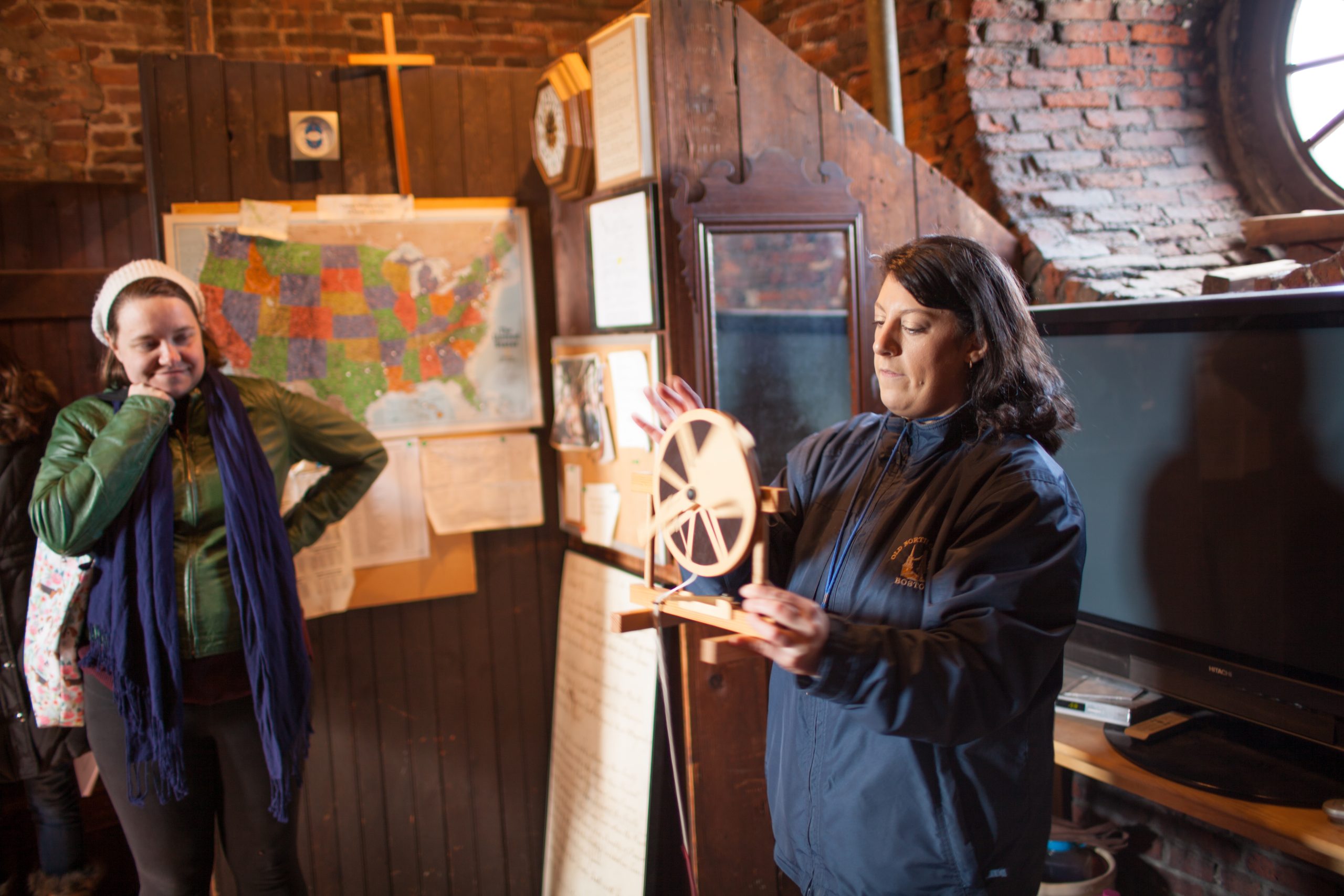
Old North has a total of 8 bells, each cast to ring at a different pitch. The treble bell, or #1, is the smallest bell and weighs in at about 620 lbs. The largest is the tenor, or #8, which weighs about 1,500 lbs. Each bell is hung inside a wooden wheel and frame, with ropes attached that extends to the bell-ringing chamber two floors down. A colored covering on the ropes called a “sally” indicates where the ringer must catch the rope, and also helps prevent rope burn.
One ringer is assigned to each bell, and begins by bringing the bell into an “up” or “live” position (meaning the mouth of the bell is facing upward, which makes it look upside-down to us). As the bell ringer pulls on the rope, the momentum carries the bell around to the other side in a pendulum motion. As the bell shifts to and fro, the clapper hits the soundbow (side of the bell) and the bell sounds in a “mouth up” position to maximize loudness. Rather than performing familiar carols, change-ringing is a mathematical performance type that creates a cascade of sounds determined by specific numeric patterns (hence the reason each bell is assigned a number between 1 and 8).
Today, Old North’s ringing group is the Boston Change Ringers. The same ringers are responsible for ringing at the Church of the Advent in Beacon Hill. The bells at Old North are rung every Sunday after the 11 am service, as well as after special occasions and holidays like the 4th of July. Watch the video embedded in this section for a Q&A with the Boston Change Ringers! Special thanks to Dale Winter and the Boston Change Ringers for contributing to the bell ringing content on this page.
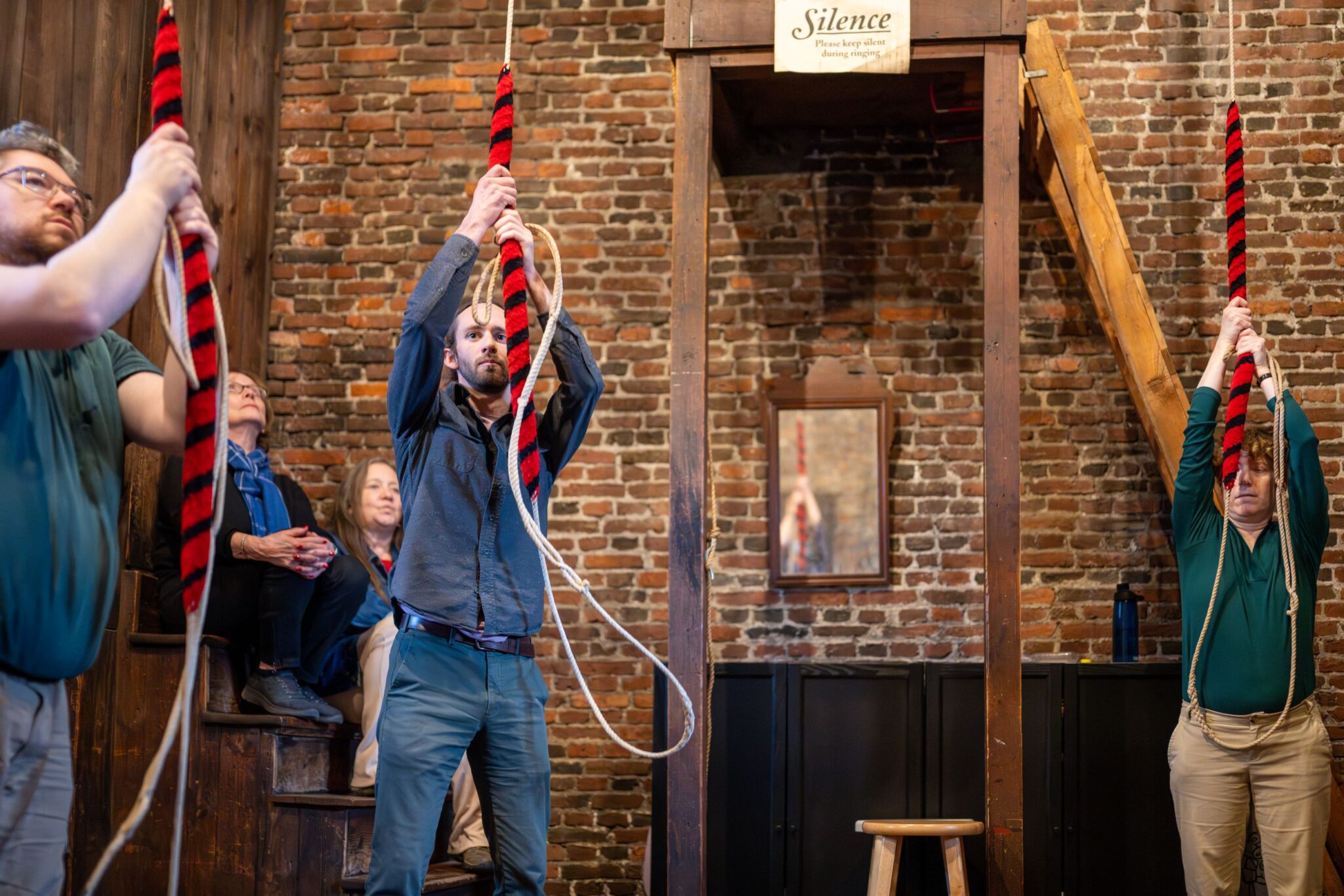
On a typical weekend, multiple shorter pieces (~5-10 minutes) are played on Saturdays as part of the Ringers’ two-hour practice time, as well as after Sunday services. Occasionally, the Ringers will also attempt a quarter peal, which is a mid-length performance of about 45 minutes. These performances are conducted from memory and without any breaks or swapping out of ringers.
Twice a year, a full peal is attempted at Old North. Peals are long performances which take about two and a half to three hours on our bells. They are often rung to mark important events in the lives of the ringing group members or the wider community (i.e. births, weddings, deaths, and inaugurations).
Full peals are incredibly complex, with each bell ringing at least 5,000 times. As these attempts are also performed without any memory aids or breaks, they require a great deal of concentration and physical exertion. Ringers will often spend months studying for these performances, and successfully completing a peal is the gold standard way for a ringer to establish their mastery in the change-ringing method.
Change ringing
The traditional English style of bell ringing in which intricate patterns, rather than songs, are played.
Tenor bell
The lowest pitched bell. At Old North, the tenor bell is the largest bell, weighing 1,545 lbs.
Permutation
The different orderings of bells in the ringing sequence.
Rhythm
Pattern of sound set to a regular beat or pulse.
Method
The various permutations or patterns of ringing the bells. It starts with a descending scale and then changes the order of the bells so that each bell rings in a different place in the pattern.
Steeple Keeper
The person responsible for the upkeep of the bells and bell ringing chamber.
Peal
A specific type of change-ringing performance in which a full method is played. There are many technical requirements for peals including that they must be played without breaks from memory and each bell must ring at least 5,000 times. Full peals can last hours depending on the number of bells and complexity of the method.
Ringing Master
The leader or conductor of the bell ringing group.
Scale
A set of musical notes ordered by ascending or descending pitch.
Read More About Our Iconic Steeple
Viewed as a symbol of liberty by many Americans, Old North’s steeple has been at the center of many stories.